

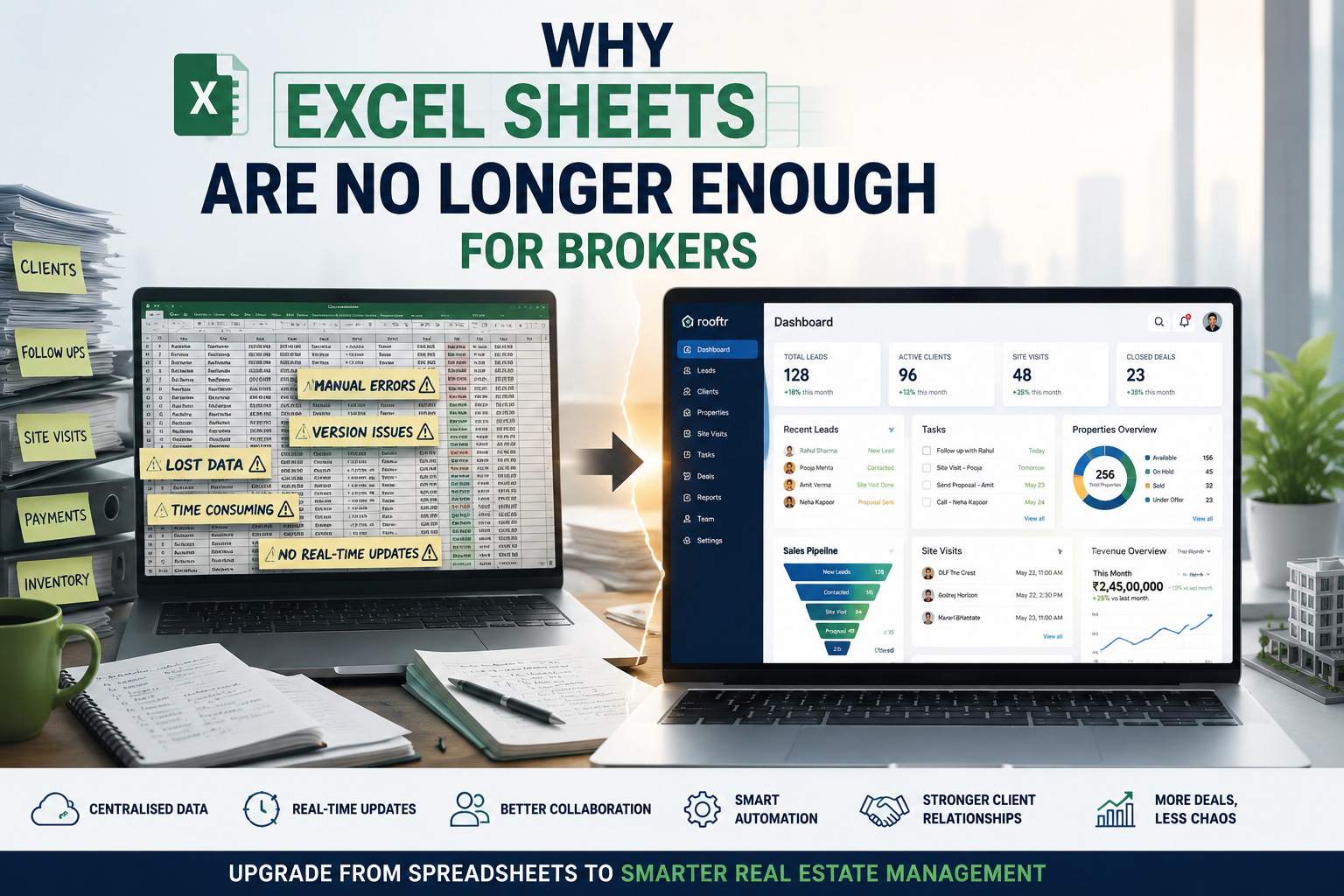
For years, Excel sheets were considered the backbone of the brokerage industry. Brokers used spreadsheets to manage property listings, client databases, payment records, leads, and follow-ups. They were affordable, flexible, and easy to access.
However, the real estate industry has changed rapidly in the last few years. With increasing competition, rising customer expectations, and the growth of digital platforms, relying only on Excel sheets is now becoming inefficient for many brokers.
Today, real estate businesses handle hundreds of leads, multiple communication channels, digital marketing campaigns, and large property inventories at the same time. In such an environment, manual spreadsheet management often slows down operations instead of improving them.
Increasing Data Has Become Difficult to Manage
One of the biggest reasons brokers are moving beyond Excel is the sheer volume of data.
A modern brokerage firm may deal with:
- Hundreds of client inquiries every month
- Multiple property categories
- Site visit schedules
- Legal documentation
- Payment tracking
- Social media and online leads
Managing all this information manually through spreadsheets increases the chances of:
- Duplicate entries
- Missed follow-ups
- Human error
- Data loss
- Poor coordination between teams
According to several CRM industry studies, businesses using automated customer management systems often respond to leads faster and improve conversion rates compared to businesses relying on manual systems.
In real estate, where timing plays a major role in closing deals, delayed responses can directly impact sales.
Consumer Expectations Have Changed
Technology has also changed buyer behaviour.
Modern customers expect:
- Quick responses
- Instant property details
- Virtual tours and digital brochures
- Regular updates
- Personalized recommendations
Research across the property sector shows that online property searches and digital communication now dominate the early stages of home buying. This means brokers are expected to stay available across platforms like WhatsApp, email, websites, and social media.
Tracking these interactions through Excel sheets becomes difficult as the business grows.
For example, if a broker receives leads from multiple platforms daily, manually updating spreadsheets for every inquiry consumes significant time and increases the risk of losing potential clients.
Rise of CRM and Proptech Platforms
The growth of Proptech (Property Technology) has transformed how brokerage firms operate.
CRM (Customer Relationship Management) software is now widely used by brokers to:
- Track leads automatically
- Schedule follow-ups
- Manage inventories
- Store client communication history
- Analyse sales performance
- Improve team collaboration
Unlike spreadsheets, CRM systems centralize all information in one place and reduce dependency on manual work.
Many platforms also use automation and AI-based tools to recommend properties, send reminders, and track customer engagement.
This allows brokers to focus more on relationship-building and negotiations instead of administrative tasks.
Better Collaboration and Scalability
Excel sheets often work efficiently for individual brokers or small teams. However, as firms expand, coordination becomes more complicated.
In larger brokerage businesses:
- Multiple agents may access the same data
- Teams work from different locations
- Real-time updates become necessary
Traditional spreadsheets can create confusion when multiple users edit files simultaneously. In contrast, cloud-based systems allow teams to work together in real time with better accuracy and transparency.
Research on workplace productivity also shows that digital workflow systems improve efficiency and reduce operational delays compared to manual data handling methods.
Data Security Is Becoming More Important
Real estate businesses deal with sensitive information such as:
- Client identities
- Financial details
- Property documents
- Agreements and contracts
Excel files stored locally are more vulnerable to accidental deletion, corruption, or unauthorized sharing.
Modern CRM and cloud-based systems provide:
- Backup storage
- Access control
- Encrypted data protection
- Recovery options
As digital fraud and cybersecurity concerns continue to rise, data security is becoming a major priority for brokerage firms.
Conclusion
Excel sheets remain useful for calculations, reporting, and small-scale data management. However, the demands of today’s real estate market require faster, more organized, and technology-driven systems.
The brokerage industry is increasingly moving toward CRM software, automation tools, and PropTech platforms to improve efficiency, customer service, and data management.
In a highly competitive market, success is no longer only about having property listings — it is also about how effectively brokers manage information, communication, and client relationships.
Original blog Source (Published by Rooftr):
Disclaimer: The content published on Rooftr is for informational and industry awareness purposes only and this blog is completely research based.